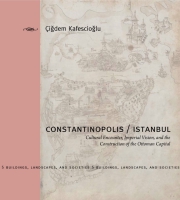


Constantinopolis/Istanbul
Cultural Encounter, Imperial Vision, and the Construction of the Ottoman Capital
Çiğdem Kafescioğlu
Constantinopolis/Istanbul
Cultural Encounter, Imperial Vision, and the Construction of the Ottoman Capital
Çiğdem Kafescioğlu
“Çiğdem Kafescioğlu’s elegant study examines the creation of the Ottoman capital of Istanbul through the reformulation of the Byzantine capital of Constantinople. The book provides clarity, nuance, and new perspectives on a formative period in the city’s history. It is well written, engaging, packed with valuable observations, and based on important new archival documents. This is a significant contribution to urban history in general and to the history and architecture of Byzantine Constantinople and Ottoman Istanbul in particular.”
- Media
- Description
- Reviews
- Bio
- Table of Contents
- Sample Chapters
- Subjects
Winner of the 2011 Spiro Kostof Award sponsored by the Society of Architectural Historians.
Publication of this book has been aided by a grant from the Millard Meiss Publication Fund of the College Art Association
Çiğdem Kafescioğlu traces the construction and representation of Ottoman Istanbul, threading histories of politics, culture, and architecture into the fabric of the urban landscape. Attentive to the preservation and destruction of artifacts from the past, Constantinopolis/Istanbul shapes an understanding of emerging modes of spatiality and visuality in Ottoman Istanbul as central components of a complex and fascinating urban process, that of the creation of a capital city through the interpretation and appropriation of another.
“Çiğdem Kafescioğlu’s elegant study examines the creation of the Ottoman capital of Istanbul through the reformulation of the Byzantine capital of Constantinople. The book provides clarity, nuance, and new perspectives on a formative period in the city’s history. It is well written, engaging, packed with valuable observations, and based on important new archival documents. This is a significant contribution to urban history in general and to the history and architecture of Byzantine Constantinople and Ottoman Istanbul in particular.”
“Linking the rebuilding of the conquered city to the building of the empire, Kafescioğlu traces interventions to urban and architectural forms, interweaving them with shifting political, ideological, and religious issues. The arguments are powerful and convincingly presented. The research is top-notch and integrates material from many sources, including an impressive range of hitherto untapped archival documents.”
“Kafescioğlu argues that the foundations of Istanbul’s later development were laid out in the first decades following the conquest, but this involved a complex dynamics in which diverse cultural traditions, Ottoman and Byzantine, along with Renaissance ideas of ordering the urban environment encountered each other. . . . [Constantinopolis/Istanbul] will undoubtedly remain an important resource for new Istanbul studies for years to come.”
“For Byzantinists, 1453 is an ending, for Ottomanists, a beginning. For the history of the city neither is correct, one of the important contributions of this book. Byzantinists need to engage this new book and to rise to its challenges. . . . Constantinopolis/Istanbul is our best analysis of the early history of the Ottoman City.”
“Constantinopolis/Istanbul is a painstakingly researched and documented and lavishly illustrated account of the city from 1453–1581. Its numerous maps, photographs, and plates combine with the written analysis to produce an in-depth study which will be of great value to both specialists and general readers.”
“There is much to recommend in Ciğdem Kafescioğlu’s carefully researched and elegant book, not the least of which is a thorough analysis of the transformation of Byzantine Constantinople into Ottoman Istanbul.”
Çiğdem Kafescioğlu is Associate Professor of History of Art and Architecture at Boğaziçi University.
Contents
List of Illustrations
Introduction
1. Between Edirne and Kostantiniyye: The City’s First Ottoman Years
2. Constructing the City: The Architectural Projects
Part 1: The Urban Program and Mehmed’s Foundation
Part 2: The Patronage of the New Ruling Elite
Part 3: Memory, Space, and Vision in Constructions of the Ottoman Capital City
3. Representing the City: Constantinople and Its Images
4. Istanbul Inhabited
Epilogue: A Picture from Circa 1537
Notes
Bibliography
Index
Introduction
Hence the slash (/) confronting the S of SarraSine and the Z of Zambinella has a panic function: it is the slash of censure, the surface of the mirror, the wall of hallucination, the verge of antithesis, the abstraction of limit, the obliquity of the signifier, the index of the paradigm, hence of meaning.
—Roland Barthes, S/Z
A symbolic locus embodying and representing myriad meanings, the political center of the eastern Mediterranean, and one of the largest urban centers of the world, Constantinople/Istanbul has been the site of large-scale urban and architectural interventions several times in the course of its history. Changing visions, changing political, cultural, religious orientations of those who lived there and those who ruled from there, have been inscribed in its spaces, transforming it, lending it new meanings. This book is about such a period of change and remaking: the decades following the city’s capture by the Ottomans in 1453, during which a grandly conceived urban project was implemented to reconstruct the capital of Eastern Rome as the capital of the Ottoman Empire. Through these decades, the construction of the city was fundamentally interlocked with the construction of empire. As the empire was built up around reorientations political and cultural and the creation of a new concept of sovereignty and a new ruling elite, so the space and image of Constantinople, too, were constructed. The millennium-old center of the Eastern Roman Empire was not merely a setting for the profound changes that took place in the Ottoman realm in the latter half of the fifteenth century. Possession of the city was the primary catalyst in the transformation of the Ottoman polity into an empire; the city was the site that would accommodate, represent, and reproduce the new configuration of the Ottoman polity.
This study explores the dialectical relationship between the Ottoman urban project and the city’s Byzantine layout and architecture, its historical legacy, and its inhabitants. It investigates the mechanisms and patterns of building, preserving, altering, and representing the urban environment during a formative period, and the meanings communicated through these acts. In short, this book attempts to explain the spatial and visual aspects of early Ottoman Istanbul as central components of a complex and fascinating urban process, that of the creation of a capital city through the interpretation and appropriation of another.
That creation was ultimately the product of the fall/conquest of the city, an event that led to the encounter of diverse cultural traditions on a site of immense significance and to profound transformations in the Ottoman political realm itself. The selective appropriation of the imperial legacy of Byzantine Constantinople was central to the making of Ottoman Istanbul, as were Ottoman urban and architectural practices of the preconquest period. Through a set of connections between the Ottoman and Italian courts, Renaissance ideas of ordering the urban environment played a significant role in the conceptualization and realization of new projects. The tension between Mehmed II’s imperial vision and the ethos of the frontiers found reflections in the first Ottoman undertakings in the new capital. Situated between the Byzantine, Latin, and Ottoman worlds, ghazi (Islamic frontier-warrior) and imperial ideologies, the city became a physical and symbolical site upon which contrasting visions and perceptions would be projected, where cultural meanings would be contested, negotiated, and remade.
This was a time, largely erased as it was from Istanbul’s later histories and documents, when a marble relief of the Byzantine eagle marked the monumental portal of the newly built commercial center, when city views meant to represent either Byzantine or Ottoman Constantinople conspicuously displayed symbols of the other, when a man by the name of Mustafa son of Yanni lived in a quarter that was alternately called the neighborhood of Aya Kenisası (“Saints Church”) and the neighborhood of the Mevlana Husrev masjid. The image of Christ Pantokrator at the summit of Hagia Sophia’s dome watched over the Muslim congregation in the great nave below. “El Gran Turco” read the caption of a kingly portrait in Mehmed II’s collection of Italian prints; it was a likeness of John VIII Palaeologos, adapted to represent the Ottoman sultan as triumphant warrior. Hence Barthes’s slash transposed to the space between Constantinopolis and Istanbul, where it will serve as the mirroring edge against which the city’s many selves are defined, imagined, represented. For if history and topography render this a site whose multiple selves will perpetually face, mirror, confront, and define each other across time and across social and physical space, these attributes assume particular import through the period with which this book concerns itself.
1453 and After
It may not be wrong to assume that the huge army that laid siege to Constantinople in 1453 included the whole spectrum of Ottoman polity of the later fifteenth century: the empire builder in the person of the sultan, grandees of Balkan and Byzantine aristocratic origin, an army of converted Christian recruits, a landed aristocracy that had constituted the ruling elite of the state until and into the reign of Mehmed II, frontier warlords and their retinues of ghazis, dervishes, recent converts, and those uprooted in the tumultuous atmosphere of late medieval Anatolia and the Balkans. The two major factions within this wide spectrum were the builders of the sedentary state and the soldiers of the frontier, whose power and dynamism were based on the semi-independence of their political and military conduct. To the former, Constantinople was the natural locus of power; ruling from the city would make the House of Osman the foremost ghazis within the realm of Islam and simultaneously inheritors of the legacy of Eastern Rome. To the latter, Constantinople was no more than a particularly prestigious object of war and conquest; the significance of its takeover lay in the erasure of an inauspicious Byzantine presence in the midst of Muslim territory. Hence, Mehmed II’s declaration, shortly after the conquest, that Constantinople was the seat of his throne, and his first measures in restoring and repopulating it, marked the first steps in the final resolution of the tension between state building and unrestrained military activity on the frontiers: the rebuilding of the city was constitutive of the building of empire. In the process, the frontier ethos and its propagators, a foundational component of the Ottoman polity since its modest beginnings as a tiny principality in Bithynia a century and a half before, would be marginalized within the Ottoman political spectrum, ceding to an increasingly pivotal center and its agents.
The figure of Mehmed II (r. 1451–1481) looms large over the Ottoman world of the fifteenth century. He was the motor force behind the cultural and political reorientations and transformations that took place in the Ottoman realm and the restructuring of the administrative apparatus that followed the conquest of Constantinople. His realization of an ancient dream of the Islamic realm earned him the title ebū’l-fetĥ, “father of conquest.” Further conquests in the Balkans and in Anatolia erased the last remnants of Byzantium and of the post-Seljuk principalities in the region, diminished the hold of Genoese and Venetian trading establishments in the Aegean and the Black Sea, and brought under Ottoman unitary rule a region that had remained politically fragmented for nearly four centuries (fig. 1). The primary and persistent motive that shaped Mehmed II’s rule was creation of a world empire governed from Constantinople by a centralized administrative apparatus. To that end, he diminished the power of the landed aristocracy and of the frontier lords, replacing them with a new military-administrative elite of devşirme (Christians conscripted for service in the palace or the army) and a larger janissary army. In an effort to centralize the learned establishment and to endow it with a hierarchical structure, he founded the Eight Colleges (Semāniye) as part of his new mosque complex in the new capital; here learned men (‘ulemā) of the highest rank would be educated. Creation of a new style of rulership was central to the foundation of empire. Assuming royal titles of the highest order, hünkār, ģān, sultan, caesar, and ebū’l-fetĥ, Mehmed II invented a new court ceremonial and conduct emphasizing his seclusion from his subjects, which highlighted his absolute authority and the sacredness of his person. The mode of rule articulated through his reign, based on Turco-Mongol, Irano-Islamic, and Byzantine notions of kingship and sovereignty and resonating with contemporary political currents in the Euro-Mediterranean sphere, was to shape the conduct of the Ottoman house, with transformations, through the following century and beyond. A ķānūnnāme (law code), written after 1477 captured and encoded for subsequent generations of Ottomans the imperial ideology and practice that were elaborated throughout Mehmed II’s reign; in particular, it defined and detailed the structure of the administrative, military, and religious hierarchies and sanctioned imperial seclusion and the custom of royal fratricide.
Imperial claims brought new notions of cultural patronage, through which the Ottoman world embraced the high cultural traditions with which it had come into contact. Thus Mehmed’s patronage extended beyond Ottoman domains, to the arts and sciences of the Iranian and the Italian worlds, as well as to Greek men of letters. He collected Byzantine relics and works of art and aspired to surpass that empire’s glory and splendor. His imperial ambitions, however, were set on Italy, so he closely followed the innovations in the arts, architecture, and military technology there. The wide scope of the sultan’s cultural patronage reflected his self-image as world emperor (figs. 2, 3, 4). Conquest and consolidation effected cultural encounters, which in turn gave shape to the dynamic eclecticism and inclusivism characteristic of the fifteenth-century Ottoman world in general and Ottoman court culture in particular.
The Byzantine capital was in a ruinous state at the time of its fall. Stripped of its hinterland by the Ottoman expansion of the previous century, impoverished by successive Ottoman sieges of the preceding decades, it is estimated to have housed forty to fifty thousand people in its vast expanse. Its reconstruction aimed, of course, to reverse its destitute state but also to re-create it as the locus of the Ottoman world. In this process, the imperial heritage of Byzantium was selectively appropriated or rejected, as is powerfully exemplified by the conversion of Hagia Sophia, the religious and political center of Eastern Christendom, into the royal mosque of the city and the subsequent demolition of the equestrian statue of Justinian that stood nearby. As Mehmed II’s centralizing policies were enacted and his vision of empire and of himself as emperor crystallized in the later decades of his rule, the city was given shape to accommodate those changes and to embody and manifest that vision. His two major additions to the city, a palace and a mosque complex conceived in 1459 and built through the 1460s and 1470s, created the spaces in the city where his authority over the military and the religious elite became manifest. The building projects of the ruling elite—including religious and charitable institutions, commercial structures, palaces, and waterways—contributed to the revival of the city. At the same time, the architecture of these urban institutions, the buildings of the monarch and the ruling elite, reflected their new hierarchical structure; the formal hierarchies introduced into the cityscape bespoke the a new political and cultural order. A monumental format and a working infrastructure were thus created for a capital conceived at an enormous scale. Reconstruction entailed repopulation: invitations to the city and grants of property, as well as forced resettlement of Muslim, Christian, and Jewish communities from other parts of the Ottoman realm, aimed at the creation of a thriving cosmopolitan capital.
The Historiography of Conquest and Construction
The fall/conquest of Constantinople added a new set of narratives to the rich constellation of histories, myths, and memories that have, over centuries, interpreted the city and its past, making them intelligible to a diverse spectrum of audiences. The political and cultural consequences of the final demise of the Byzantine Empire have rendered the city’s “fall” or “conquest” an enormously charged topic in Byzantine, Ottoman, and Western cultural traditions alike. Texts originating in these milieus, in separate veins but at times merging with each other, have told and retold the stories of this important moment in the life of the city. Encapsulated in the emotional charge of the words “fall” and “conquest” and written into the histories and myths of Constantinople is a complex of perceptions and visions concerning the city and the realm to which it belongs.
Whether to lament the fall of the city or to celebrate its long-desired capture, historical accounts of this period focus largely on the momentous events of spring 1453, detailing episodes and moments of the siege, the capture, the sack. Ottoman chronicles written from the later fifteenth century onward, whether narrating the history of the dynasty or events of the reign of Mehmed II, have summary or detailed sections on Mehmed’s efforts to rebuild and repopulate Constantinople. They narrate the sultan’s order to his grandees to undertake constructions of public and private buildings in Constantinople, and they report also on the grand vizier’s constructions. These accounts, full of praise for the sultan’s enormous endeavor, constitute the first examples of the Ottoman historical narrative that asserts that Istanbul owed its rebirth and its subsequent prosperity as the Ottoman capital to Mehmed II. The early-sixteenth-century historian Neşri presents this position succinctly: “In short, Sultan Mehmed Han built Istanbul, and he made it flourish in such a way that travelers today say ‘there is no city like it in the universe.’” Some decades later Sa‘düddin described how the city became an abode where innumerable people lived and worked comfortably under the peace-giving shadow of the sultan. In the seventeenth century, Evliya Çelebi, when detailing the deportation of communities to the capital, wrote of Mehmed II’s Constantinople as the wealthy, thriving city he was proud to inhabit. Tracing these narratives through time reveals also the steps in the making of a myth: a century after Evliya Çelebi, Hafız Hüseyin al-Ayvansarayi, writing his Ĥadīķatü’l Cevāmi‘ (Garden of Mosques), attributed a large number of quarter mosques to those who had partaken in the 1453 siege, thereby inscribing stories of the conquest onto the space of the city. (Ayvansarayi’s partly false attributions, in turn, figure prominently in most modern accounts of the early Ottoman city.)
The writings of contemporary and later authors no doubt attest to the grand enterprise of the sultan in the rebuilding and repopulation of the new capital. They are not, however, the only accounts dealing with the subject. Narratives originating from the milieu of frontier warriors, who were increasingly marginalized by the new state, tell a strongly contrasting tale of Constantinople’s reconstruction. The authors and audiences of those texts understood only too well that the move from the former capital Edirne to Constantinople was part of a centralizing policy and that empire building was its corollary. Their strong opposition to both is clearly manifested in historical narratives such as the anonymous Tevārīģ-i ’Āl-i ‘Oŝmān (chronicles of the House of Osman), which portray the sultan’s attempts to restore and revitalize the city as markedly less successful than those depicted in narratives originating from the “center”: “Even a sultan like Mehmed restored it with difficulty in three, four years, and so many parts of it are still in ruins.” The objection to the rebuilding itself is wonderfully demonstrated in a text completed ca. 1474, that is, after the most intense period of building activity in the new capital was already over. An imaginary conversation between Mehmed and his commanders prior to the siege of the city captures the sense of exasperation prompted by the sultan’s urban venture. The commanders warn the ruler: “Because of adultery and sodomy and lewdness and debauchery, black waters emerged from its ground at night, and it remained ruinous. [. . .] If you rebuild this city, it will destroy the world, and you will be the cause of this destruction. It will never flourish. However many times you build it, it will fall back into ruin again.”
These narratives are of documentary as well as historiographic value. On the one hand, they provide insights into the contrasting and competing meanings of Constantinople within the fifteenth-century Ottoman world, meanings to which I return in the following chapters. On the other hand, they provide insights into the making of the city’s Ottoman and, later, modern Turkish history. While the accounts that narrated the conquest and the subsequent restoration of the city as tales of glory remained central in the historiography of the dynasty and of the city, those which referred to Constantinople as the site of doom and destruction and voiced objections to its status as Ottoman capital were either marginalized or domesticated into mainstream accounts. These texts are reminders that Mehmed II’s grand urban project was realized only with the estrangement and marginalization of many, at huge costs to Ottoman subjects and treasury alike. Not surprisingly, it was the former picture, not the latter, that survived the passage of time.
New images of the Conqueror and the Conquest were fabricated in the later nineteenth century, when Ottoman intellectuals revisited court chronicles and the complex of narratives on Mehmed II and his spiritual, political, and military companions in popular histories, hagiographies, and topographic accounts. At a time when (control over) imperial territory eroded, with the Ottoman elite compelled to respond to a rapidly changing political and ideological landscape, emergent modes of historicist thinking offered Ottoman intellectuals a new framework for imagining and representing the imperial past. In the writings of Namık Kemal, one of the prominent intellectuals of the Ottoman nineteenth century, the golden age of Ottoman rule, the “age of conquest” (devr-i istīlā), was re-created, its zenith marked by the conquest of Constantinople. In articulating notions of nationhood (millet) and fatherland (vatan) to become the building blocks of an emerging nationalist imagination tightly anchored to notions of dynastic continuity, Kemal endowed Mehmed II, who had occupied a central place in Ottoman historiography, with new significance. Now referred to as the Conqueror (Fatih), he became the ultimate symbol of an age of glory, a bygone era of conquests summoned to stand in stark contrast to a present of losses. More significantly, Istanbul, the city, and 1453, the date, provided spatial and temporal anchor points to the inchoate ethos of nationhood, since the conquest was now a chapter in the history of the Ottoman millet, and the city was the center of the territorial entity it inhabited. The conquest marked an honorable beginning, that of Ottoman (“national”) history as history of empire.
“One rarely searches for beginnings unless the present matters a great deal,” wrote Edward Said. An imaginative and emotional need for unity underlies the quest for beginnings, for the beginning provides sequential, moral, or logical order to an otherwise diffuse set of circumstances. The promise of unity and cohesiveness embodied in the idea of the beginning, in turn, works to fix and theologize knowledge, whereby the beginning, ceding its place to that which it gave rise to, assumes virtuality. Said’s “meditation on beginnings” may help explain the continued import of the Conqueror and the Conquest in modern Turkish historiography, once they were salvaged from the pages of manuscripts and rendered part of a “national” historical narrative. A large body of literature on the subject has been produced from the last decades of the nineteenth century onward, with significant additions around 1953, when the five hundredth anniversary of the conquest of Constantinople provided opportunity for celebration for those riding on an ascending wave of nationalism. The program of commemorations included publication of studies, as well as editions and facsimiles of numerous fifteenth-century literary and historical works. At the same time, the “celebrations” marked 1453 and its associations as an increasingly crucial, at times fetishized, symbol for strands of nationalism within the Turkish political spectrum. During the last decade of the twentieth century and the first decade of the twenty-first, the Conqueror and the Conquest have become subjects of contestation in a polarized political landscape whose diverse constituents have (mostly) different claims on the Ottoman past. The debate has brought into sharper focus what are ostensibly contradictory aspects of the Conqueror’s character and conduct. An anachronistic and exclusionary nationalism and religious zeal and an equally anachronistic progressivism are by turns attributed to Mehmed II: to some, the Conqueror is the foremost warrior of Islam, who captured and converted into a Muslim and Turkish city the heart of Eastern Christendom; to others, he is a Renaissance prince in Ottoman garb, an enlightened, progressive, European-oriented ruler.
What I broadly outline here is the process by which the conqueror and the conquest were constructed as sites of memory central to Ottoman and, later, modern Turkish historical consciousness. That construction (and perhaps the Constantinople of the fall as a differently constructed site of memory to Greek historical imagination) should be a subject of scrutiny in itself. My sketch, however, has a different aim: to highlight the ways in which the process of construction following 1453 is represented in the modern historiography of the city. For the writing on this period and on its foremost figure has shaped and colored the ways in which modern scholarship has approached the city, as it has the ways in which modern urbanism and urban conservation have interpreted and treated the remains of this period. While the majestic figure of the conqueror came to overshadow everything else in the fifteenth century, the image of his Istanbul as the glamorously built capital was reinforced. Little attention was given to other histories or to documents that would complicate the narratives of Istanbul’s reconstruction, revealing (instead of overlooking) the complexities and the chaotic aspects of that process.
While this overview has focused on the historiography of conquest and reconstruction in Ottoman and modern Turkish scholarship, it should be noted that some of the premises of modern historiography, shaped in turn by orientalist and nationalist legacies, bear on Western scholarship on Byzantine as well as Ottoman cultural history in comparable ways. Turkish and Western scholarship alike have largely abided by widely accepted geographic (Middle Eastern versus Western), religio-cultural (Islamic versus Christian), and nominally dynastic but in effect ethno-religious (Ottoman versus Byzantine) divides, which have in turn tended to obfuscate connections across those categorizations or hindered the use of alternative frameworks. In one of the fascinating spatiotemporal constructions of modern historiography (effected also, but not only, by a history of conflict and coexistence of two world religions in this complex cultural landscape), Constantinople, as it were, abandons its Roman (read Western) context on 29 May 1453 and becomes part of a different geography: the Islamic, or the Middle Eastern, world. This year has thus constituted a neat and precise dividing line in scholarship on the city, seldom crossed, incontrovertibly separating the “Byzantine” and the “Ottoman” domains. Questions regarding Ottoman uses of forms associated with Byzantine architectural culture have often fallen into the trap of a loaded debate of “influences,” rendering it difficult, if not impossible, to understand the products of a complex cultural environment marked with interactions, fluidity, and hybridity. Likewise, questions regarding connections between Ottoman and Byzantine urbanistic practice have seldom drawn interest. Recent cultural history has been altering this picture of insular fields and particularistic approaches, introducing important insights into shared histories and cultural contacts and interrelationships across the larger medieval and early modern worlds.
The fifteenth century figures prominently in several studies of Ottoman architectural history. The bibliography and references of the present study will make apparent the important ground covered by earlier scholarship on the topic. The construal of Ottoman architecture of the later fifteenth century in these works once more evokes Said’s observations in his Beginnings. Under the spell of Ottoman Istanbul’s classical image, which largely took shape in the second half of the sixteenth century, modern scholarship has tended to understand the city’s premodern urban and architectural history as a continuum, regarding the first Ottoman works in Istanbul, in terms of their conception and design, as the first steps in a linear and evolutionary scheme that culminated in the grand projects of a later era of magnificence. Despite a strong current of continuity in the Ottoman architectural tradition, a focus on the evolutionary dimension of that history obscures significant aspects of fifteenth-century Istanbul and its architecture that had more to do with the complex cultural dynamics of the era than with any future traditions to which they gave rise.
Within the framework of urban history—or, more precisely, the vaguely defined area within urban history that concerns itself with aspects of urban spatiality and visuality—Ottoman Istanbul has often been lodged either on the “organic” or the “Islamic” side of dichotomous and mutually exclusive categorizations. The Islamic city model, a product of orientalist scholarship largely based on an essentialist understanding of Islam as the foremost determinant of urban culture in the Middle East, has been the subject of an extensive debate from the 1950s onward. The writing on urban history from the 1990s onward has covered considerable ground in historicizing the urban processes of particular periods and areas and hence problematizing the essentialist aspects of the model, if not doing away with it altogether. Where Ottoman studies are concerned, a somewhat different picture emerges. Created and elaborated by scholars of the medieval Islamic world, the Islamic city paradigm (based in turn on Weberian urban theory, which relied heavily on definitions of the city in medieval Europe) could never embrace early modern Istanbul as comfortably as it did medieval Aleppo or Fez. Scholarship on Ottoman history, in its turn, has until recently proved itself rather disinterested in historical processes connecting, or dividing, the larger Islamic world. Tacit acceptance of received opinion, then, rather than attempts to create or apply models, has at times led scholars to the Islamic city model for interpreting the shape and the structures of the Ottoman capital.
It might be useful to regard the organic and the Islamic city models together in terms of their bearing on the study of Ottoman urbanism, although these represent distinct lines of inquiry in urban history. For where spatial configurations are concerned, both models presume the absence of a geometric principle ordering the urban environment, a geometry regarded as a constitutive aspect of Western urbanism by virtue of the mark it has left on cities of the Greco-Roman, Renaissance, and post-Renaissance eras. The absence of a geometric principle shaping the city, in turn, has been read as an indicator of spontaneous development of urban structures, whereby builders possess neither the will nor the ability to premeditate on a grand scale the formal, functional, and symbolical implications of their interventions in the cityscape. Recent work has brought important changes to this picture. The organic city paradigm has been divorced from the presumption of spontaneity, while work on Ottoman cities has explored alternate ways in which urban configurations took shape, acquired and manifested meaning.
This Study
Alongside nationalist historiographies or equally rigid civilizational divides, the mere absence of an in-depth study on the topic, too, accounts for the obscurity of important aspects of Istanbul’s first Ottoman decades. It is one of the objectives of this book to fill this gap, presenting a layered and multifarious picture of the city through this era, highlighting the complexity of the urban process that transformed Constantinople and the hybridity of its spaces and images. I construe the Ottoman capital city as the product of a range of encounters, dialogues, and oppositions between different actors within the Ottoman realm as well as between the Ottomans, Byzantium, and the West. Beyond that immediate locus, interconnections, parallelisms, and incongruities in the emerging early modern world (of which the Ottomans were part) constitute a parallel theme in my exploration of urbanistic trends in fifteenth-century Istanbul. Investigating aspects of urban spatiality and visuality beyond strict categorizations of planned and unplanned, and stepping outside of the geometric paradigm within or against which urbanism has often been evaluated, this study aims to reveal the urbanistic notions at work in the ordering of Istanbul’s urban environment during a formative period. The book delineates emerging urbanistic trends in Constantinople/Istanbul in their connections to the making of a new political structure, underscoring the ways in which the urban interventions of this era bear on the shape of Istanbul in later centuries. Equal emphasis, on the other hand, is placed on those aspects of the fifteenth-century city that were to be erased from its mainstream historiography.
This book focuses on the first three decades of Istanbul’s Ottoman history. Three interrelated themes constitute its framework: monumentalization, representation, and inhabitation. Here, monumentalization refers to a building program that aimed to establish and communicate the city’s new identity as the center of the Ottoman realm through the introduction of a new visual and spatial order to the urban environment. This new spatial and formal hierarchy, created through the construction of Ottoman monuments and the selective appropriation of Byzantine sites and monuments, in turn represented, accommodated, and engendered a new political and social order. Urban monuments, in this framework, were at once buildings intended to communicate a range of meanings to diverse audiences and sites that enabled their users to partake of the urban space and its practices.
By portraying, surveying, accentuating, and at times silencing symbolically significant sites or consequential events, the city’s images projected the visions and claims of their makers regarding those particular sites or events and the city at large. My exploration into modes and manners of representing the urban body extends to visual and literary images of Constantinople/Istanbul, as well as to archival documents such as imperial edicts or property surveys that offer insights into the cultural meanings bestowed on and projected by the city and its parts. A dialogic of representation is particularly pertinent to this subject: products of an era of political and cultural encounters and transformations, these images escape singular interpretations with clear and distinct meanings. Whether pictures, poems, chronicles, or epics, that is, whether iconic or narrative, they often convey a range of contrasting perceptions regarding their highly symbolic subject. My analysis aims to capture the plurality that constitutes the city’s representations, for this offers an entry into the plurality that constitutes the city at large.
An inhabited city coexisted with that created through monuments and images. The city’s commercial and residential fabric were woven from political and cultural processes that gave shape to these monuments and images as much as from the workings of daily life. The formation of that fabric and its interrelationship with the city’s monumental structure and image are integral to an understanding of the larger urban process with which this book concerns itself. By looking into the formation and use of residential and commercial patterns and into the social, political, and institutional processes underlying these patterns, I delineate aspects of the immediate material environment of the city’s inhabitants. At the same time, this inquiry into the formation of residential and commercial patterns reveals Ottoman notions of city and urbanity, informed by Islamic legal practices, on the one hand, and by newly articulated notions of spatial hierarchy, on the other.
I regard these the three main aspects of the making of the city, interrelated processes that reshaped its physical space and its image, investing both with new meanings. Inspired by Henri Lefebvre’s triad of the conceived, the represented, and the lived, whose dialectical relationship underlies the production of space, this conceptual framework provides the means for a synchronic exploration of the multiple processes that informed the transformation of the capital of Eastern Rome into the capital of the Ottoman Empire. While the main themes that underlie and structure my study—monumentalization, representation, inhabitation—broadly relate to Lefebvre’s triad, the correspondence is neither literal nor complete. My inquiry into the dialectics of the physical, the mental, and the social mediates an entry into an exploration of emerging modes of spatiality and visuality operative in a particular urban setting.
The primary sources of this study—histories, epics, hagiographies, poetry, archival documents, and visual images—constitute repositories of data pertaining to the material environment of the fifteenth-century city and the social, political, and institutional processes that shaped its urban environment. These documents are simultaneously analyzed in this book as representations of Constantinople, providing insights into the attitudes, perceptions, and claims of the makers of those documents with regard to the city.
It is surely not coincidental that the later fifteenth century marks the first significant outburst of Ottoman historical writing, concerning both the history of the Ottoman dynasty from its humble beginnings and the contemporary history of the period. Cemal Kafadar, writing on the birth of an Ottoman historical consciousness in the era following the Timurid invasion of Anatolia, has suggested that the resolution of the interregnum subsequent to the Ottoman defeat and the emergence of a new configuration of power (whereby the Ottomans were relegated to vassal status by their Timurid adversaries) led the Ottomans to represent themselves in historical terms. The formation of a new cultural and political configuration under the reign of Mehmed II encouraged further articulation of an Ottoman historical consciousness. Significantly, three works exclusively on the reign of Mehmed II, in Greek, Persian, and Turkish by the order of their publication, were written in the 1470s and 1480s. The chronicles of Kritovoulos of Imbros, Mu‘ali, and Tursun Beg (the first two presented to the sultan and the latter to his successor) are detailed accounts of the period and constitute important sources of information on the events of the era as much as on the varied cultural and political attitudes and dispositions of those who partook in them. A more broadly scoped work on Ottoman history as a whole, Chronicles of the Ottoman Sultans, by Karamani Nişancı Mehmed Pasha, was completed in the final years of Mehmed II’s rule.
The end of Mehmed II’s reign, as separately observed by Stéphane Yerasimos and Cemal Kafadar, brought forth a new era of reckoning, as Bayezid II’s policies made it possible to criticize Mehmed’s often harsh measures aiming to build a centralized state. Anonymous chronicles of the House of Osman, as well as those by Uruc, Aşıkpaşazade Derviş Ahmed, and Ruhi of Edirne, are products of this period, providing historical accounts of the Ottoman experience of the previous two centuries while simultaneously articulating and manifesting reactions to Mehmed’s rule. The House of Osman, in turn, produced its own versions of the consequential events of these decades: works commissioned by Bayezid II, most notably İdris Bidlisi’s Heşt behişt, in Persian (“Eight Paradises,” referring to the rules of the eight Ottoman sultans up to Bayezid II), but also Kıvami’s Fetiĥnāme-i Sulŧān Meĥmed (Book of Conquest of Sultan Mehmed), are histories dealing extensively with this period. A new historiographic line, represented by writings of the religious elite, also produced its first works around the turn of the sixteenth century. The Chronicles of the House of Osman by İbn Kemal and the Cihannümā by Mevlana Mehmed Neşri are the early examples of this genre. Not surprisingly, the rebuilding of Constantinople and the endeavors of the Ottoman ruling elite in this regard received particular attention from the authors of these chronicles.
Fifteenth- and early-sixteenth-century Greek historical writings, as exemplified by the chronicles of Doukas, Sphrantzes, and a number of anonymous authors, constitute important sources on the era and provide significant, if summary, information on the city subsequent to its fall. European visitors to and captives in the Ottoman court who wrote accounts of their stays following their return to the West—Giovan Maria Angiolello, Giovanni Antonio Menavino, Georgius of Hungary among them—offer important information and complementary views.
In the decades following the Ottoman conquest of Constantinople and the decision to make it the Ottoman capital, authors belonging to diverse segments of Ottoman society and with different attitudes toward the conquest and its aftermath produced a body of literature treating the city, its past, and its significant sites. The Patria, a collection of Greek texts on the history and monuments of Constantinople, was partially translated, upon a royal commission, into Persian (and eventually into Turkish). The city’s myriad stories, translated, adapted, and appropriated to varying ends from medieval Greek and Arabic literature, figured in anonymous chronicles and in such compilations of late medieval lore as Dürr-i Meknūn and the Śalŧuķnāme (an epic of Ottoman expansion in the Balkans compiled in the 1470s). Hagiographies of figures as diverse as the grand vizier Mahmud Pasha, the heterodox (and to Ottoman authorities highly troublesome) Sufi leader Otman Baba, and the Sufi scholar Akşemseddin (spiritual guide to Mehmed II during the siege of Constantinople) are other literary products in which the city figures as setting to a variety of narratives representing and interpreting newly emerging social and political configurations. During the same period the city and its spaces entered the realm of Ottoman poetry, in which are apparent the nascent themes and tropes through which Istanbul would be represented to its Ottoman audiences across the following centuries. Belonging to a different strand of literary production are the earliest biographical dictionaries of Ottoman poets and scholars: those by Latifi and Sehi Beg, as well as Taşköprizade’s Şaķaiķu’l-Nu‘maniyye, although works of the middle decades of the sixteenth century, are rich with information on the networks and settings of intellectual activity in fifteenth-century Istanbul.
The fifteenth century lacks the rich mines of archival documentation, such as court records and mühimme registers (compilations of imperial edicts and decrees), available to students of later Ottoman urban history. Among the available archival sources that deal with the builders, inhabitants, and buildings of the city during this period are unbound imperial edicts, surveys of urban property, sales and ownership documents, and the deeds and account books of pious endowments. The most voluminous among these are the documents related to pious endowments: individual waqfiyyas (endowment deeds) and citywide surveys of endowed property, which provide significant information on the city’s physical and social makeup, on patronage patterns involved in the creation of monuments as well as in the making of residential and commercial areas. These documents make possible a partial mapping of the city’s social and built fabric; they simultaneously provide valuable insights into notions shaping the conceptualization and organization of urban life.
Chapter 1 focuses on the first years following the conquest (1453–59). Although Constantinople was declared the capital of the Ottoman realm upon its capture, it was only in the 1460s that this decision was fully implemented. The initial Ottoman interventions in the cityscape following 1453 were responses to immediate concerns and needs, rather than parts of a larger project. Reflecting the sultan’s decision to rebuild the city on a vast scale and endowing it with some of its powerful symbols, the projects of these years of orientation and reorientation simultaneously betray a lack of clarity regarding the status of the city and the possibilities offered by its topography. The conflict between the former Ottoman order, defined by largely centrifugal forces, and the newly emerging political configuration, shaped by a centralizing vision, found reflection in the first architectural projects in the city. I focus on the main Ottoman interventions in the Constantinopolitan cityscape through these years, highlighting at once the projects that were to be subsequently marginalized and those that were to leave a permanent mark on the city.
The second chapter, “Constructing the City,” focuses on the monumentalization of urban space in its artistic, cultural, political, and social dimensions. It takes as its starting point Mehmed’s announcement in 1459 of a new campaign in rebuilding the capital and his order to members of the ruling elite to undertake constructions in the city alongside him. Three sections structure this discussion, the first devoted to the royal project, the second to the architectural patronage of the new ruling elite, and the third to an overall assessment of major Ottoman interventions in the cityscape. The architectural works constructed in response to Mehmed’s decree are evaluated as a collective enterprise of the ruling body to create the imperial capital. Here, I delineate those aspects of the architectural projects that link them to each other and justify their study as parts of an urban project, considering them in terms of their functions, architectural style, relationship to the urban environment, and their roles as centers of further urban development. Central to this discussion is the interaction between the Byzantine and Ottoman urban and architectural traditions, on the one hand, and the Renaissance ideas of ordering the urban environment, on the other.
The third chapter turns to representations of Constantinople/Istanbul. As the space of the city was transformed through a large-scale urban project that had its roots in Ottoman, Byzantine, and Italian urban practices, the city’s image, too, was remade, to represent the Ottoman capital as it emerged at the end of Mehmed’s rule. The views of the city in the numerous manuscripts of Liber Insularum Archipelagi of Cristoforo Buondelmonti, produced throughout the latter half of the fifteenth century, the Vavassore map, which is a copy of an earlier drawing dating from ca. 1480, and the image in Hartmann Schedel’s Liber Chronicarum of 1493 are analyzed in the context of the changing cultural meaning of the city concomitant with its fall/conquest. Subsequently, literary images of the city in later-fifteenth-century Ottoman sources are analyzed as textual counterparts to the visual images. I discuss the intent and meaning of these representations, situating them in their cultural and political milieus of production and use. In light of the complexities of their representational modes and content, the ambiguity and polysemy they embody, I discuss transformations in the cultural identity and meaning of the city.
The fourth chapter explores another main theme of the study, urban space as inhabited. Here, I return to the physical space of the city, its buildings, and the primary sources treating them, now to map out a residential topography of the new capital and to delineate its relationship to the city’s monumental order. I begin with a focus on the organizing principles of the archival documents relevant to the topic and the representational strategies manifest in them. Close reading of this documentation exposes ruptures between representations of the urban body and the practices that shaped it. This, in turn, sheds light at once on Ottoman concepts of urban structure and on modern interpretations of those concepts, informed by at times overly literal readings of the documents in question. Delineating patterns in the formation of new neighborhood centers and in the patronage mechanisms involved in this process, I propose a revised residential map of the city. At the same time, by tracing the first steps in the formation of the city’s residential structure, I demonstrate that this was a less straightforward process than has generally been assumed. I turn finally to the physical fabric of the residential areas, to the uses of Byzantine structures and new constructions, to reach an understanding of the tangible mass that surrounded a newly configured monumental layout.
The epilogue turns to the reigns of two successors of Mehmed, Bayezid II (r. 1481–1512) and Selim I (r. 1512–20), providing an overview of Istanbul on the eve of a second major construction boom, led by Süleyman I, which endowed the city with its “classical” features. A celebrated image of Ottoman Istanbul, Matrakcı Nasuh’s view of ca. 1537, mediates both a survey of the city at this time and a discussion of the imperial urban vision that shaped it, leading to an exploration into the interrelationships between urban representation and urbanistic practice in the Ottoman world. Comparing Matrakcı’s image to earlier representations of the city discussed in the third chapter, I locate their differences in shifts in political and cultural orientations that marked the late fifteenth and early sixteenth centuries, and in concomitant changes in patronage patterns and sponsorship of urban institutions. This brief overview (of another little-studied era in the history of Istanbul) aims to buttress one of the theses of this study: through the first decades of Ottoman rule, the formal and conceptual foundations for Istanbul’s later development were laid. But those decades also inscribed in the space of the city and in its images traces of the complex dynamics of an era when diverse cultural traditions encountered each other on a site of immense symbolic significance. By the time the Matrakcı view was created, traces of that former era were in part obscured, as a more univalent imperial vision of the capital city was articulated.
Also of Interest


Mailing List
Subscribe to our mailing list and be notified about new titles, journals and catalogs.